

The Journal
Springbank, Campbeltown: the house that did not leave
26 AUGUST 2026
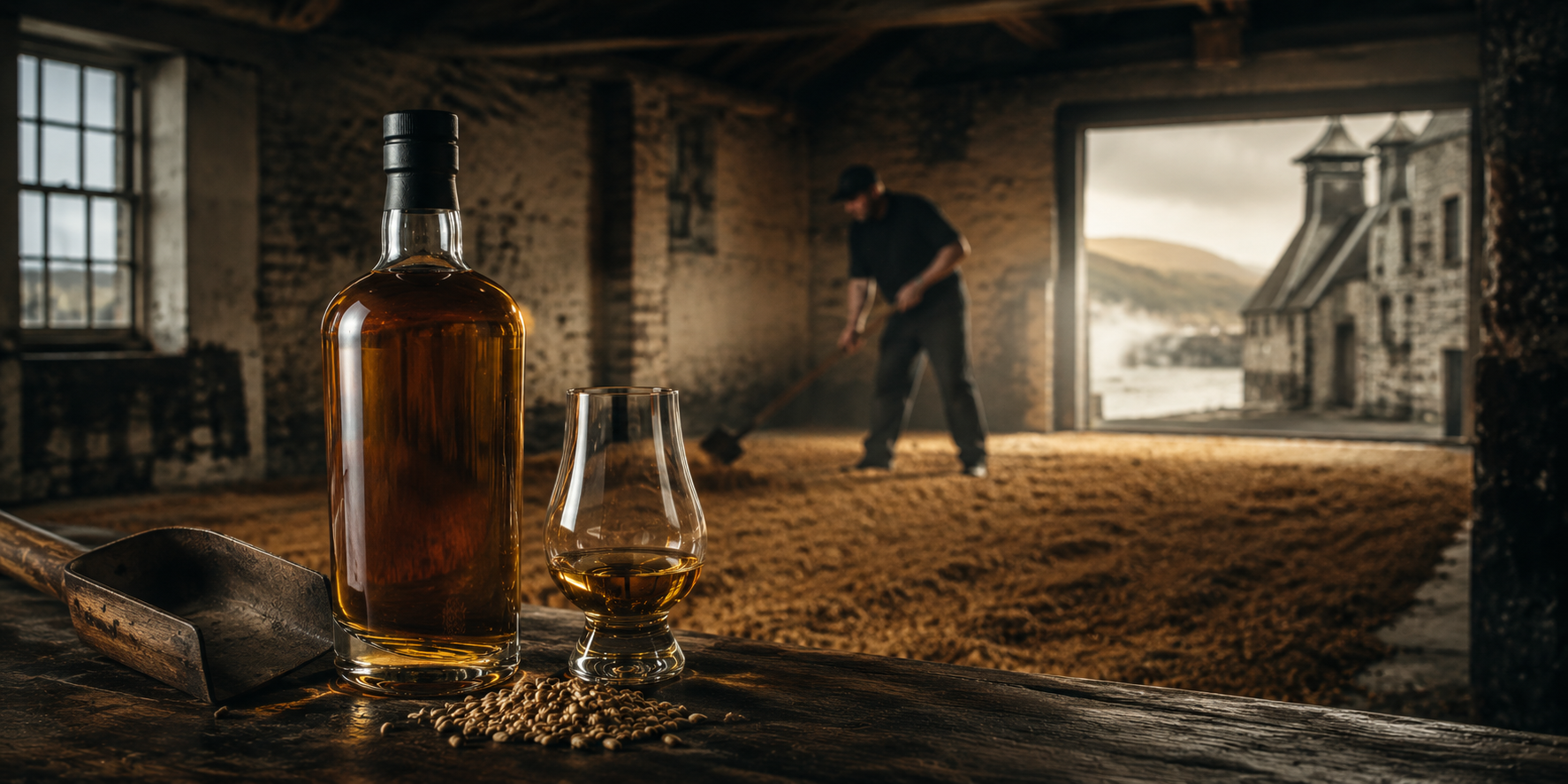
A peninsula that once distilled on an industrial scale now has three working stillhouses. Springbank is the one collectors cite when they mean craft, continuity, and a region that nearly vanished, which is why a house like this belongs on Dram X.
Collectors do not talk about Springbank as they talk about a Speyside workhorse or an island brand with a visitor centre the size of a small town. They talk about a peninsula that distilled on an industrial scale and then almost stopped; about a family that did not sell; about a stillhouse that still malts every grain it uses.
Campbeltown sits at the foot of Kintyre. Coal at Machrihanish, barley on the peninsula, a fast sea road to Glasgow, and a dense cluster of stills once turned the burgh into what Victorian writers called the whisky capital of the world. Springbank's own timeline records twenty-two legal distilleries in the area by 1814. When Alfred Barnard came through in 1885, more than twenty were still at work. Across the nineteenth century, more than thirty names came and went. Hazelburn, Longrow, Rieclachan, Glengyle: the map was a street of maltings.
It did not hold. In the 1920s some of the town's distillers, chasing volume, cheapened the make. Blenders looked elsewhere. American Prohibition closed a market; duty rose; the local coal seam failed; tastes moved toward lighter malt. One stillhouse after another went dark. Glengyle, founded in 1872 by William Mitchell after he left Springbank, ceased in 1925. Rieclachan shut in 1934. That left two: Springbank and Glen Scotia. For most of the rest of the century, Campbeltown as a whisky region was a legal memory with almost no stills to justify it.
Springbank's answer was not a rebrand. It was to keep making whisky in a way the rest of the industry had industrialised away from. When the "whisky loch" of the 1980s made even that sporadic, the firm resumed regular production in 1989 as a single-malt house rather than a supplier to blends.
A family company, then a trust
Springbank was licensed in 1828 on the site of Archibald Mitchell's illicit still, the fourteenth licensed distillery in Campbeltown. Trade histories name William Reid (related to the Mitchells by marriage) as the first licensee. In 1837 Reid's in-laws, John and William Mitchell, took ownership. John's son Alexander later joined; the firm on the label, J. & A. Mitchell, is that succession made corporate. The Mitchells had been in Campbeltown since the 1660s, some of them already maltsters. Continuity here is not a visitor-leaflet slogan. It is the ownership record.
Hedley G. Wright, Archibald Mitchell's great-great-grandson, chaired the company for more than sixty years. In 1969 he bought William Cadenhead, the Aberdeen merchant house of 1842, and folded independent bottling into the same Campbeltown firm. In 2000 he bought the silent Glengyle buildings, putting them back in the family line; the rebuilt distillery ran spirit in 2004, the first new stillhouse in Campbeltown in more than a century. When Wright died in August 2023, at ninety-two, J. & A. Mitchell said the running of the firm would not change: the arrangements had been made years before. Ownership went into three trust funds. A family member was appointed to the board. Shares in Glengyle were placed in local trusts so the town, not a trade buyer, would keep the benefit.
Glen Scotia, founded as Scotia in 1832 and now under the Loch Lomond Group, is the other nineteenth-century survivor. Kilkerran, distilled at Glengyle, is the twenty-first-century third. Campbeltown is named in the Scotch Whisky Regulations 2009 as a protected locality, with Islay, and distinct from the protected regions of Highland, Lowland and Speyside. Only whisky distilled in South Kintyre may use the name. Three working distilleries is what that indication now rests on. Springbank is the one that never left.
Everything on one site
The company's most repeated claim is also the one that explains the cult. Springbank is the only distillery in Scotland to carry out one hundred per cent of production on a single site, from barley loft to labelled bottle. It is the only one to malt all of its own barley on traditional floors. A handful of others (Balvenie, Bowmore, Highland Park, Laphroaig, Kilchoman among them) still turn a portion of their malt by hand. The rest they buy in. Springbank does not.
Barley is steeped for up to three days, spread six inches deep, and turned at intervals. It is kilned for thirty to forty-eight hours over peat, hot air, or both, depending on whether the run is Springbank, Longrow or Hazelburn. A 1940s Porteous mill crushes the malt. Mashing is in a cast-iron tun; fermentation is in six boatskin-larch washbacks, for as long as 110 hours. The wash still is fired by a live flame. Trade accounts of the plant add a worm tub on the intermediate still: less copper contact, a heavier new make. The whisky is not chill-filtered. No colouring is added. None of this is efficient. All of it is the point.
The distillation is the part other houses cannot copy by installing a single piece of kit. Springbank is distilled two and a half times. The wash still produces low wines; the strongest fraction goes forward to the spirit still, about a fifth of the final charge. The rest is redistilled in the intermediate still and joins the spirit-still heads and tails in the feints receiver. Longrow is distilled twice, from heavily peated malt. Hazelburn is distilled three times, from malt dried on air alone. One stillhouse, three malts, three different answers to peat and copper.
Longrow was first run in 1973, an experiment by the then chairman to show that an Islay-style malt could be made on the mainland. It takes its name from a lost Campbeltown distillery, as Hazelburn does (first distilled in 1997). Kilkerran cannot use the Glengyle name, already a trademark on a blended Highland malt; the substitute is older than the town's English name, from Ceann Loch Chille Chiarain. Malt for Kilkerran is made on Springbank's floors. The two stillhouses share a production team and a calendar: Springbank from January into September, Glengyle for about three months from autumn. In 2025 that meant, in the production director's figures, just shy of 260,000 litres of alcohol at Springbank and around 92,000 at Glengyle. These are not Speyside numbers. They are the arithmetic of scarcity before anyone mentions an auction.
Grain, members, and standing
The Local Barley bottling is the agricultural version of the same argument. Each year a Kintyre farm is commissioned to grow barley for a limited grain-to-glass release; farm, variety, cask mix and age change with the batch. The 2025 edition used Bere from Clochkiel. In 2026 two further local crops were malted, mashed, distilled and filled separately, to be bottled later. This is not terroir as marketing copy. It is a farm name on a label, from a peninsula that used to take such things for granted.
The Springbank Society exists because demand long ago outran the stills. Member bottlings in 2026 (a 28-year-old, filled in 35cl to stretch the parcel) are allocated, not advertised into a vacuum. David Allan, director of sales and marketing, has been blunt about the last decade: queues at the shop, bots on the website, and a secondary market that treats even the 10-year-old as a flip. Whisky sitting in a cupboard, he told The Scotsman, is no use to a distillery that lives on people who open the bottle and come back. Festival releases have been cut to 35cl so more drinkers see some. In 2025 a 5-year-old 100 Proof, all bourbon cask, 57.1% ABV, was added to the core range to put more Springbank on stripped shelves. Auction houses still treat the name as one of the few contemporary malts with the liquidity of the old collectable houses. That is standing, not a forecast. It comes from the stillhouse, not the hammer.
What 2026 actually changed
Nothing in late August altered the story. What 2026 changed is capacity around the edges, not the method.
In May, during the Campbeltown Malts Festival, J. & A. Mitchell opened a £6.2 million bottling and dispatch hall on the Glengyle site. The production brief was explicit: more case output in future years, and the old bottling hall freed for cask warehousing, with people still in place of machines wherever possible. The stills themselves were lifted out, refurbished by Forsyths, and craned back in early in the year. Yields are up and more consistent. The distillate, the company says, is the same.
The other marker is the Countdown Collection: five annual bottlings toward Springbank's bicentenary in 2028. The 2026 release, a 29-year-old, was 500 bottles by ballot. That is how a house this size marks two hundred years: not with a visitor-centre extension, but with a warehouse parcel and a queue.
Why a house like this belongs here
Dram X is a Scotch platform: bottled malt and casks; Speyside, Island, Highland, Campbeltown; Highland Park, Glenfarclas, Dalmore, Springbank. The last of those is not a fourth logo on a shelf. It is the reason Campbeltown is on the list at all.
A serious collection that only runs Speyside to Islay is a map with a hole in it. Campbeltown is the smallest of the protected names, and it is small because almost every still that made it a capital is gone. Glen Scotia keeps one nineteenth-century thread. Kilkerran is the restoration. Springbank is the through-line: licensed in 1828, Mitchell-owned since 1837, floor-malted in full, distilled two and a half times, bottled on the same ground, now held in trust rather than offered to a group. Longrow and Hazelburn are not line-extensions. They are the names of dead neighbours, still being made.
Scarcity follows from that, not from a campaign. Output in the low hundreds of thousands of litres of alcohol, a production calendar shared with Glengyle, allocations, Society bottlings, Local Barley from named farms: these are the conditions under which Campbeltown malt reaches a collector at all. Dram X does not need to invent a holding to make the case. The case is the region, the method, and the fact that almost nobody else still does this. If the catalogue is meant to represent Scotch as it is actually collected, Springbank is not an optional Campbeltown SKU. It is the house the story is about.
Sources
- Springbank Distillers, "Our Story" (timeline), https://www.springbank.scot/about/story/
- Springbank Distillers, "Introduction," https://www.springbank.scot/about/introduction/
- Springbank Distillers, "Our Process," https://www.springbank.scot/about/process/
- Springbank Distillers, "Our Distillery," https://www.springbank.scot/about/distillery/
- Springbank Distillers, "Our Whisky," https://www.springbank.scot/whisky/
- Springbank Distillers, "Springbank Local Barley" (2025 release page), https://www.springbank.scot/whisky/springbank-range/local-barley-10yo-2025/
- Springbank Distillers, "Countdown Collection: 2026 Release," https://www.springbank.scot/countdown-collection/countdown-collection-2026-release/
- Springbank Distillers, "Springbank 100 Proof" (5-year-old core range), https://www.springbank.scot/whisky/springbank-range/10yo-2025-100proof/
- Scotch Whisky.com, "Springbank" (Whiskypedia profile and history), https://scotchwhisky.com/whiskypedia/1892/springbank/
- Scotch Whisky.com, "J&A Mitchell & Company," https://scotchwhisky.com/whiskypedia/2595/j-a-mitchell-company/
- Scotch Whisky.com, "Mitchell's Glengyle," https://scotchwhisky.com/whiskypedia/2598/mitchell-s-glengyle/
- Mitchell's Glengyle / Kilkerran, homepage, https://kilkerran.scot/
- Mitchell's Glengyle / Kilkerran, "Glengyle Distillery History," https://kilkerran.scot/the-glengyle-distillery/
- Glen Scotia, "Distillery," https://www.glenscotia.com/pages/distillery
- The Scotch Whisky Regulations 2009, SI 2009/2890, regulation 10 (protected localities and regions), https://www.legislation.gov.uk/uksi/2009/2890/regulation/10
- William Cadenhead, "Announcement: Mr Hedley G Wright," 16 August 2023, https://www.cadenhead.scot/2023/08/announcement-mr-hedley-g-wright/
- WhiskyCast, "Hedley G. Wright: 1931-2023," 16 August 2023, https://whiskycast.com/hedley-g-wright-1931-2023/
- Findlay Ross, Director of Production, J. & A. Mitchell, "Wrapping Up 2025 at Springbank" (Society letter), December 2025, via The Clan Maccurve, 24 December 2025, https://maccurve.be/2025/12/24/wrapping-up-2025-at-springbank/
- J. & A. Mitchell Society update, "So Far at Springbank in 2026," 19 July 2026, via WhiskyIntelligence, https://www.whiskyintelligence.com/2026/07/so-far-at-springbank-in-2026-scotch-whisky-news/
- Hannah O'Hanlon, "Drams flow as Springbank opens new £6.2million bottling hall," West Coast Today, 21 May 2026, https://www.westcoasttoday.co.uk/news/drams-flow-as-springbank-opens-new-62million-bottling-hall
- The Scotsman, "Springbank's big Campbeltown launch will see more whisky on the shelves and stop it being the holy grail" (David Allan interview), https://www.scotsman.com/lifestyle/food-and-drink/springbanks-big-campbeltown-launch-will-see-more-whisky-on-the-shelves-and-stop-it-being-the-holy-grail-5071212
- Edinburgh Whisky Academy, "Scotch Whisky Distilleries with On-Site Floor Maltings," 5 February 2025, https://www.edinburghwhiskyacademy.com/blogs/feature/scotch-whisky-distilleries-with-on-site-floor-maltings
- Whisky Auctioneer, Springbank distillery page (secondary-market reputation, not prices), https://whiskyauctioneer.com/learn/explore-whisky/distilleries/springbank